

Sitting is something most people do every day without thinking much about it.
You sit while working.
You sit while studying.
You sit during meetings, travelling, eating or relaxing at home.
For many people, a large part of the day involves remaining in a seated position.
At first, this may not feel uncomfortable.
However, after several hours, you might notice that your lower back feels stiff, your neck feels tight or your hips feel uncomfortable when you stand up.
You may find yourself stretching your back, rolling your shoulders or walking around briefly to relieve the discomfort.
Sometimes the stiffness disappears once you begin moving.
Other times, it may return as soon as you sit down again.
This can leave you wondering whether your posture is the problem, whether your chair is causing the discomfort or whether sitting for long periods is affecting your body.
The answer is not always straightforward.
Sitting is a normal human activity, and sitting itself does not automatically damage your spine, hips or joints.
However, remaining in one position for an extended period can contribute to stiffness and discomfort, particularly when your body has limited opportunities to move throughout the day.
Understanding why sitting all day can leave your back, neck and hips feeling stiff can help you recognise what may be contributing to the discomfort and make practical changes to your daily routine.
Why Does Sitting All Day Make Your Body Feel Stiff?
Your body is designed to tolerate different positions and movements.
You can sit, stand, walk, bend, reach, squat and perform many other activities.
Each position places different demands on your muscles, joints and surrounding tissues.
Sitting generally reduces the amount of movement required from several areas of your body.
Your hips remain bent.
Your knees remain flexed.
Your back maintains a relatively similar position.
Your neck may remain directed towards a computer screen, phone or another object.
Your shoulders may stay in a similar position while typing or using a mouse.
None of these positions is automatically harmful.
However, remaining in them for long periods may become uncomfortable.
Muscles can feel tired from maintaining a relatively fixed position.
Joints may feel temporarily stiff after extended inactivity.
You may also become more aware of discomfort in areas that have been under sustained demand.
For example, someone who has been sitting through several meetings may experience lower back stiffness when standing.
Another person may notice neck discomfort after working on a laptop throughout the afternoon.
Someone else may feel tightness around the front of the hips after a long journey.
Although these experiences are common, they do not necessarily have the same cause.
Stiffness is a symptom rather than a diagnosis.
It does not automatically mean that a muscle has become permanently shortened, a joint has been damaged or your posture has caused a structural problem.
The important consideration is how your body responds to prolonged sitting and whether the discomfort improves when you change position or begin moving.
What Happens to Your Muscles When You Sit for Long Periods?
Muscles are involved in much more than exercise.
They help you maintain positions, control movement and support everyday activities.
Even when you are sitting relatively still, certain muscles continue working to help maintain your position.
The amount of muscular effort depends on how you are sitting and whether your body is supported.
For example, sitting upright without back support may require more sustained muscular effort than sitting comfortably against a supportive chair.
Reaching forward towards a keyboard may place different demands on your shoulders and upper back compared with keeping your arms supported.
Over time, maintaining a position can become tiring.
You may begin shifting your weight, leaning against one armrest or adjusting your shoulders.
These movements are often your body’s way of finding a more comfortable position.
Muscle discomfort may develop when the demands of remaining in a particular position exceed what feels comfortable for you.
This does not necessarily mean the muscles are weak.
It also does not mean that strengthening exercises are the only solution.
Sometimes changing position, taking a brief walk or adjusting the workstation can reduce the demand.
Other times, improving general physical activity and muscular endurance may help you tolerate daily activities more comfortably.
1. Lower Back Stiffness After Sitting
The lower back is one of the areas people commonly associate with prolonged sitting.
You may notice discomfort after working at a desk, driving for several hours or sitting through a long meeting.
Sometimes the stiffness appears gradually.
At first, your back may feel comfortable.
After an hour or two, you might begin shifting in your chair.
You may lean forward, sit upright, cross your legs or stretch your back.
Eventually, standing up may feel uncomfortable.
Your lower back might feel tight for the first few steps before the discomfort begins to settle.
There are several possible reasons for this.
Why Does Your Lower Back Hurt After Sitting?
Sitting places your lower back in a relatively sustained position.
Depending on your chair, workstation and preferred sitting style, your spine may remain more rounded or more upright.
Neither position is automatically dangerous.
However, staying in the same position for a long time can become uncomfortable.
Your lower back muscles may experience sustained demand.
You may also be less accustomed to remaining seated for long periods.
Previous episodes of back pain, stress, poor sleep and other factors can influence how sensitive your back feels.
The total amount of sitting throughout the day also matters.
For example, someone may spend eight hours working at a desk.
They may then drive home for an hour.
After dinner, they might spend another two hours sitting on the couch.
Even if they take occasional breaks at work, their overall day may still involve relatively little movement.
This does not mean that every hour spent sitting causes damage.
It simply means there may be fewer opportunities to change position and engage in other physical activities.
Is Slouching Bad for Your Lower Back?
Slouching is frequently blamed for back pain.
You may have been told to sit completely upright, keep your shoulders back and avoid rounding your spine.
However, back pain is more complicated than maintaining one supposedly perfect posture.
People naturally sit in different ways.
Some prefer a more upright position.
Others feel comfortable leaning back.
Some occasionally round their lower back.
These positions are not automatically harmful.
The problem may arise when you remain in a position that becomes uncomfortable and continue holding it without changing.
Trying to maintain a rigid upright posture for several hours can also become tiring.
Rather than forcing your body into one fixed position, aim to sit comfortably and adjust your position regularly.
The goal is not to maintain perfect posture every minute.
The goal is to avoid remaining uncomfortable for unnecessarily long periods.
What Can Help Lower Back Stiffness From Sitting?
If your lower back becomes stiff after sitting, consider how your day is structured.
You may benefit from:
- Standing up periodically
- Walking for a few minutes
- Changing your sitting position
- Using a chair that feels comfortable and supportive
- Adjusting your desk and screen position
- Taking movement breaks between meetings
- Avoiding prolonged periods in one uncomfortable position
- Gradually increasing your general physical activity
- Performing comfortable back movements
- Reducing uninterrupted sitting time where practical
You do not necessarily need a complicated stretching routine.
Sometimes standing up, walking to another room or changing position is enough to make the area feel more comfortable.
However, persistent lower back pain should not automatically be blamed on sitting.
If symptoms continue, worsen or interfere with normal activities, consider seeking professional assessment.
2. Neck Pain From Sitting at a Desk
Neck discomfort is another common complaint among people who spend long periods working on computers.
Your neck supports your head while allowing you to look in different directions.
It is involved whenever you look at a screen, read a document, use your phone or turn towards another person.
During desk work, your head may remain in a similar position for extended periods.
For example, you might spend several hours looking slightly downward at a laptop.
You may lean forward to read small text.
You might turn your head repeatedly towards a second screen.
Or you may hold your phone between your shoulder and ear while completing another task.
These activities can place sustained demands on the muscles around your neck and shoulders.
Over time, the area may begin to feel tired, uncomfortable or stiff.

Why Does Your Neck Feel Tight After Computer Work?
Neck stiffness does not always mean there is something structurally wrong with your neck.
Sometimes the discomfort may be associated with remaining in a similar position for too long.
The muscles around the neck help control the position of your head.
When you keep your head relatively still for extended periods, those muscles may experience fatigue or sustained tension.
Your workstation can influence how comfortable the position feels.
For example, a laptop placed too low may encourage you to look downward for prolonged periods.
A screen positioned too far away may cause you to lean forward.
A monitor placed significantly to one side may require repeated head turning.
These factors do not guarantee that pain will develop.
However, they may contribute to discomfort in some individuals.
Is Looking Down at Your Phone Damaging Your Neck?
Looking down at your phone is a normal movement.
Your neck is capable of bending forward.
The movement itself is not automatically harmful.
However, spending long periods looking downward without changing position may become uncomfortable.
For example, someone who uses their phone for a few minutes may experience no symptoms.
Another person who spends several uninterrupted hours looking down may notice stiffness.
The difference is not simply the angle of the neck.
Duration, comfort, previous symptoms and the total demands placed on the body may all contribute.
You do not need to avoid looking down completely.
Instead, consider changing position regularly and taking breaks when discomfort begins.
What Can Help Neck Stiffness?
If your neck becomes uncomfortable during desk work, consider:
- Adjusting your screen to a comfortable viewing height
- Increasing text size if you frequently lean forward to read
- Positioning frequently used screens directly in front of you
- Taking short breaks from sustained screen use
- Moving your neck gently through comfortable ranges
- Relaxing your shoulders periodically
- Supporting your arms where comfortable
- Alternating between tasks when possible
- Avoiding holding your phone between your shoulder and ear
- Changing your position before discomfort becomes significant
Gentle movements may include slowly turning your head from side to side or looking up and down within a comfortable range.
These movements should not cause significant pain.
Avoid forcing your neck into uncomfortable positions.
If neck pain is persistent, severe or accompanied by symptoms such as arm weakness, numbness or difficulty with coordination, seek medical assessment.
3. Hip Stiffness After Sitting All Day
Your hips allow your legs to move in several directions.
They are involved in walking, running, climbing stairs, squatting and standing up from a chair.
When you sit, your hips remain in a bent position.
This is called hip flexion.
Hip flexion is a normal movement.
Your hips are designed to tolerate it.
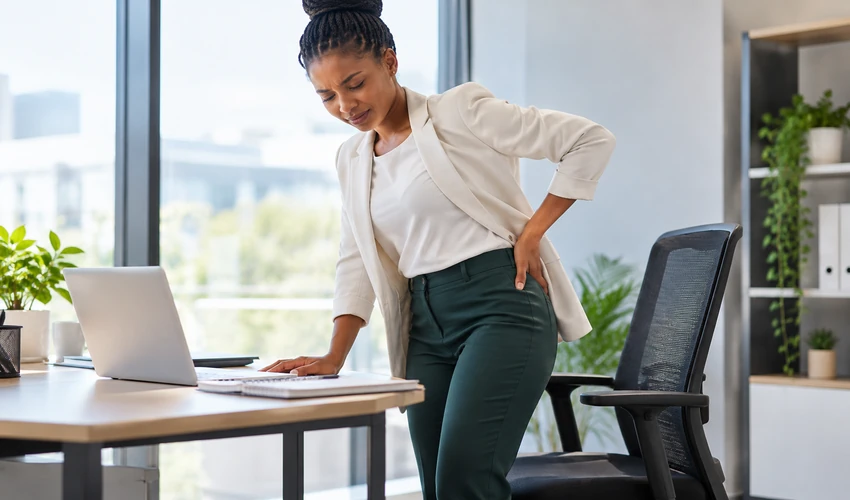
However, after remaining seated for a long time, you may notice stiffness around the front, sides or back of the hips.
For example, you might stand up after working for several hours and feel uncomfortable during your first few steps.
You may need to walk around briefly before your hips feel more comfortable.
Some people describe the sensation as tightness.
Others feel a dull ache or general restriction.
These experiences can have different causes.
Do Your Hip Flexors Become Tight From Sitting?
The hip flexors are a group of muscles involved in bringing your thigh towards your body.
They also contribute to different movements and aspects of stability.
When you sit, your hips remain flexed.
This places some hip flexor muscles in a relatively shortened position.
However, this does not mean sitting for several hours automatically causes permanent muscle shortening.
Feeling tight is not the same as having a muscle that has structurally shortened.
A sensation of tightness may also be influenced by muscle fatigue, sensitivity, reduced movement or other factors.
For example, someone may feel stiffness at the front of the hips when standing after a long journey.
After walking for a few minutes, the sensation may improve.
This does not necessarily mean the muscles have suddenly lengthened.
Movement may simply make the area feel more comfortable.
Why Do Your Hips Feel Stiff When You Stand Up?
Standing requires your hips to move from a flexed position towards extension.
If you have remained seated for several hours, this change may initially feel uncomfortable.
Your muscles and joints are moving through positions they have not used much during that period.
You may experience temporary stiffness that improves as you begin walking.
However, not all hip discomfort comes from prolonged sitting.
Hip pain may also be associated with joint conditions, tendon problems, referred pain from the lower back or other causes.
The location of pain alone cannot reliably identify the problem.
Persistent groin pain, significant loss of hip movement or discomfort affecting normal walking should be assessed professionally.
What Can Help Hip Stiffness From Sitting?
Consider introducing more opportunities to move throughout the day.
You might:
- Stand up between work tasks
- Walk during short breaks
- Change your sitting position
- Practise comfortable standing movements
- Perform gentle hip movements
- Take short walks after long journeys
- Avoid forcing painful stretches
- Gradually increase daily walking
- Include suitable strengthening exercises
- Reduce long periods of uninterrupted sitting
For example, after sitting for several hours, you might walk around your home or office for a few minutes.
You may also find gentle hip movements comfortable.
However, you do not need to perform aggressive stretching to make your hips feel normal again.
The appropriate approach depends on what is contributing to the discomfort.
4. Shoulder and Upper Back Tension From Desk Work
Although lower back, neck and hip stiffness receive significant attention, prolonged sitting can also be associated with discomfort around the shoulders and upper back.
Think about how your arms are positioned during the working day.
You may spend hours typing.
You might use a mouse repeatedly.
You may reach forward towards your laptop.
Your shoulders may remain relatively still while your hands perform small repeated movements.
These activities place demands on the muscles around the shoulders and upper back.
Why Do Your Shoulders Feel Heavy After Sitting?
The muscles around your shoulders help position your arms and control movement.
During computer work, some muscles may remain active for extended periods.
If your desk is too high, you may find yourself lifting your shoulders while typing.
If your keyboard is far away, you may repeatedly reach forward.
If your arms have little support, maintaining their position may become tiring.
These situations can contribute to discomfort.
However, shoulder tension is not always caused by workstation positioning.
Stress, sleep, previous injuries and general activity levels may also influence how the area feels.
Should You Always Keep Your Shoulders Back?
You do not need to hold your shoulders rigidly backwards throughout the day.
Constantly forcing your shoulders into one position can create additional muscular effort.
Instead, allow them to remain comfortable.
Adjust your workstation where necessary.
Move your arms and shoulders regularly.
Change position when you begin feeling uncomfortable.
A comfortable and adjustable working position is generally more useful than trying to maintain a perfectly fixed posture.
5. Why Your Body Feels Worse After a Long Day of Sitting
You may start your day feeling comfortable.
Your back feels normal.
Your neck moves easily.
Your hips do not feel stiff.
However, by late afternoon, several areas may begin feeling uncomfortable.
This can happen even when you have not performed any physically demanding exercise.
One possible explanation is the accumulation of sustained physical demands throughout the day.
For example, you may have:
- Sat through several meetings
- Worked continuously on a laptop
- Driven for an extended period
- Taken very few movement breaks
- Remained in a similar position for hours
- Worked while feeling stressed
- Slept poorly the previous night
- Spent little time walking
- Continued working despite increasing discomfort
Each factor may contribute differently.
The total demands of the day can influence how comfortable your body feels.
This is why changing only one element, such as buying a new chair, does not always resolve the problem.
Your overall routine matters.
6. Can Sitting Too Much Make Your Muscles Weak?
Sitting for several hours does not automatically make your muscles weak.
However, spending much of your time sedentary may reduce the opportunities your muscles have to perform more demanding activities.
Muscles adapt to the activities you regularly perform.
Walking, climbing stairs, lifting, carrying and resistance training all place different demands on the body.
If your routine involves very little physical activity, your strength and physical capacity may be lower than they would be with regular exercise.
This does not mean sitting directly damages your muscles every time you use a chair.
Instead, it highlights the difference between time spent sitting and the amount of physical activity performed throughout the day.
Someone may work at a desk but also walk regularly, exercise and remain physically active outside working hours.
Another person may spend most of the day sitting and perform very little additional movement.
Their overall physical demands and fitness levels may be different.
Can Exercise Help If You Sit All Day?
Regular physical activity can support muscular strength, cardiovascular fitness and general health.
It may also improve your ability to tolerate different daily activities.
For example, someone who regularly walks and performs suitable strengthening exercises may gradually develop greater physical capacity.
However, exercise is not a guaranteed solution for every type of back, neck or hip pain.
Pain can have several contributing factors.
A person experiencing persistent discomfort may need more individualised guidance.
The aim is to build a routine that includes movement rather than relying on one exercise to correct the effects of sitting.
7. Is There Such a Thing as Perfect Sitting Posture?
Many people believe there is one correct position that everyone should maintain while sitting.
They may try to:
- Keep their back completely straight
- Hold their shoulders backwards
- Keep both feet perfectly aligned
- Avoid leaning to either side
- Maintain the same position throughout the working day
However, people have different body proportions, preferences, workstations and physical needs.
A position that feels comfortable for one person may feel uncomfortable for another.
There is no single sitting posture that guarantees freedom from pain.
An upright position may be comfortable for some tasks.
Leaning back may feel better during others.
Changing position is a normal part of sitting.
The important question is whether your working position is comfortable and whether you can adjust it when necessary.
Why Constantly Correcting Your Posture May Not Help
Imagine spending an entire working day trying to sit perfectly straight.
You may continuously pull your shoulders back.
You may keep your abdominal muscles tense.
You might avoid leaning against your chair because you believe doing so is unhealthy.
Eventually, maintaining that position can become tiring.
Instead of reducing discomfort, you may create unnecessary muscular effort.
A more practical approach is to find a comfortable position, use available support and change position periodically.
Your best sitting position does not have to be the same throughout the day.
8. How Often Should You Get Up From Your Desk?
There is no single movement-break schedule that is ideal for everyone.
The amount of sitting a person tolerates comfortably can vary.
Your work responsibilities, physical condition and activity level also influence what is practical.
However, interrupting prolonged sitting with regular movement is a sensible habit.
Some people find it helpful to stand up approximately every 30 to 60 minutes.
This can be a starting point rather than a strict medical rule.
You might prefer shorter, more frequent breaks.
Alternatively, you may need to organise your breaks around meetings or work tasks.
The important consideration is avoiding unnecessarily long periods of uninterrupted sitting.
What Can You Do During a Movement Break?
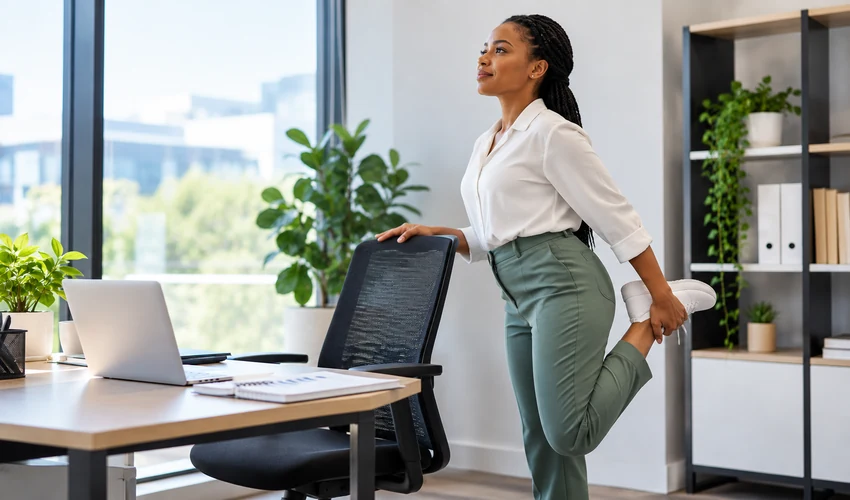
You do not need to complete a full workout.
A movement break might involve:
- Walking around the office
- Standing while making a phone call
- Walking to refill your water
- Taking a short walk between meetings
- Gently moving your shoulders
- Changing your sitting position
- Performing comfortable standing movements
- Walking to another room
- Using the stairs if appropriate
- Standing up briefly before returning to work
Even simple changes can provide an opportunity to move out of the position you have been maintaining.
If an activity increases your discomfort significantly, avoid forcing it.
9. Can Stretching Reverse the Effects of Sitting All Day?
Stretching is frequently recommended for people who experience stiffness after sitting.
You may have heard that tight hip flexors need stretching or that back stiffness must be corrected through specific movements.
Stretching can be useful for improving flexibility and may provide temporary relief from some types of discomfort.
However, it is not a universal solution.
A sensation of tightness does not always mean a muscle is physically too short.
Not every painful area needs to be stretched.
For some people, gentle movement may feel more comfortable than holding a prolonged stretch.
Others may benefit from a combination of mobility exercises, strengthening and changes to their daily routine.
The appropriate approach depends on the symptoms.
Should You Stretch Through Pain?
Avoid assuming that a painful stretch becomes more beneficial when you push harder.
Mild stretching sensations can be normal.
Sharp pain, increasing discomfort, numbness or unusual symptoms are different.
If a stretch clearly aggravates your symptoms, stop or modify it.
Forcing movement into a painful range is not necessary to improve flexibility.
If stiffness is persistent or significantly restricts movement, professional guidance may be useful.
10. Is Standing All Day Better Than Sitting?
Standing desks have become popular among people who want to reduce their sitting time.
They can provide another working position.
However, standing for long periods is not automatically better for every part of your body.
Prolonged standing can also become uncomfortable.
Some people experience tired legs, lower back discomfort or foot pain after standing for several hours.
Simply replacing eight hours of sitting with eight hours of standing does not necessarily solve the problem.
Is a Sit-Stand Desk Worth Using?
A sit-stand desk may be helpful if it allows you to change position throughout the day.
For example, you might sit while completing detailed computer work.
You could stand briefly during another task.
Later, you may return to sitting.
The benefit is the opportunity to vary your position rather than remaining in one posture for the entire working day.
A sit-stand desk is not essential for everyone.
You can also interrupt sitting by walking, standing during breaks or changing tasks.
The most practical solution is one you can maintain consistently.
11. Why You May Feel Stiff Even When You Exercise Regularly
Some people assume that regular gym training should prevent all discomfort associated with sitting.
However, being physically active does not guarantee that every position will always feel comfortable.
You may exercise for an hour in the morning and spend the rest of your day sitting.
You might perform demanding strength training but still experience neck discomfort during long periods of laptop work.
These activities involve different physical demands.
Someone may have excellent leg strength but find prolonged sitting uncomfortable.
Another person may walk long distances but experience shoulder fatigue while working at a desk.
This does not necessarily mean their exercise programme is ineffective.
It simply shows that physical capacity is specific to different activities and demands.
Does One Workout Cancel Out a Full Day of Sitting?
Regular exercise provides important health benefits.
However, a workout does not automatically eliminate every concern associated with prolonged sedentary behaviour.
Research distinguishes between overall physical activity and sedentary time.
Both can be relevant to long-term health.
For example, someone may meet recommended exercise targets but still spend many hours sitting.
Another person may not attend a gym but regularly walk, perform household activities and move throughout the day.
A balanced approach considers both planned exercise and ordinary movement.
Rather than focusing only on one workout, consider how active you are across the entire day.
12. Common Mistakes People Make When Trying to Reduce Sitting-Related Stiffness
Forcing Perfect Posture
Trying to maintain one rigid position throughout the working day can be tiring.
A comfortable posture should not require constant muscular tension.
Allow yourself to change positions.
Stretching Aggressively
Some people respond to stiffness by performing intense stretches.
They assume that the more uncomfortable the stretch feels, the more effective it must be.
However, aggressive stretching may aggravate some symptoms.
Start with comfortable movements rather than forcing painful positions.
Ignoring Discomfort for Hours
You may notice stiffness developing but continue working without changing position.
By the end of the day, the discomfort may feel more noticeable.
Consider introducing movement breaks before discomfort becomes significant.
Buying Equipment Without Changing Habits
A new chair, cushion or standing desk may improve comfort.
However, equipment alone may not address prolonged uninterrupted sitting.
Your daily routine remains important.
Avoiding Movement Because of Mild Stiffness
Some people become worried when their back or hips feel stiff.
They may avoid bending, walking or performing ordinary movements because they assume discomfort means damage.
However, mild stiffness does not automatically indicate injury.
Comfortable movement is often reasonable.
Persistent or concerning symptoms should still be assessed appropriately.
Trying to Change Everything at Once
You may decide to introduce a standing desk, a new workout programme, several stretching routines and frequent movement breaks simultaneously.
Although these changes may seem positive, making too many adjustments at once can make it difficult to identify what is useful.
Start with manageable changes.
Observe how your body responds.
Build gradually.
13. The Role of Your Workstation
Your workstation can influence how comfortable you feel during prolonged computer use.
However, there is no universal setup that will eliminate discomfort for everyone.
The goal is to create an environment that allows you to work comfortably and adjust your position when necessary.
Chair Height
Your chair should allow you to sit comfortably while reaching your keyboard and desk.
If your chair is too high, your feet may not rest comfortably on the floor.
If it is too low, you may need to raise your shoulders or reach upwards while working.
Adjustments should be based on comfort and practical use.
Screen Position
A screen positioned too far away may encourage you to lean forward to see the content.
A screen placed significantly below your usual line of sight may require more sustained downward viewing.
Consider positioning your screen where you can look at it comfortably.
If you work on a laptop for long periods, using a separate keyboard and mouse may make it easier to adjust the screen independently.
Keyboard and Mouse
Your keyboard and mouse should be positioned where you can use them without unnecessary reaching.
If your mouse is far away, you may repeatedly move your arm into an uncomfortable position.
If your keyboard is too high, your shoulders may remain elevated.
Small adjustments can sometimes improve comfort.
Back Support
Some people prefer using the backrest of their chair.
Others find certain tasks more comfortable while sitting forward.
You do not need to remain in contact with the backrest at every moment.
However, having support available may help reduce sustained muscular effort during some tasks.
Workstation Adjustments Are Not a Cure
Even a well-designed workstation cannot guarantee that you will never experience pain.
Your symptoms may also be influenced by physical activity, sleep, stress, previous injuries and other health factors.
Use workstation adjustments as one part of your overall approach.
14. Why Sleep and Stress Can Influence How Stiff Your Body Feels
Musculoskeletal discomfort does not occur in isolation.
Your body’s response to everyday activities can be influenced by several factors.
Sleep is one of them.
Poor sleep may affect pain sensitivity, energy levels and your ability to cope with physical demands.
For example, a working position that usually feels comfortable may seem less tolerable after several nights of inadequate sleep.
Stress can also influence how your body feels.
During stressful periods, some people experience greater muscle tension or become more aware of physical discomfort.
You may notice that your shoulders feel tense during demanding workdays.
You might develop neck discomfort during periods of prolonged concentration.
However, this does not mean every episode of stiffness is caused by stress.
Persistent symptoms should not automatically be dismissed as psychological or lifestyle-related.
Consider the wider context.
Ask yourself:
- Have I been sleeping adequately?
- Have my working hours increased?
- Am I spending more time sitting than usual?
- Have I reduced my normal physical activity?
- Have I been experiencing higher stress?
- Have I changed my workstation?
- Have I recently experienced an injury?
- Do my symptoms improve when I move?
These questions may help identify patterns.
They cannot provide a medical diagnosis.
15. How to Add More Movement to a Sedentary Working Day
Making your day more active does not necessarily require major lifestyle changes.
Small adjustments may be easier to maintain than completely reorganising your routine.
Consider how movement could fit into different parts of your day.
Before Work
If practical, take a short walk before starting your working day.
You might walk outside, move around your home or perform a few comfortable movements.
The aim is simply to introduce physical activity.
You do not need to complete an intense workout.
During Work
Look for natural opportunities to interrupt sitting.
You may be able to:
- Stand between meetings
- Walk while taking a suitable phone call
- Refill your water regularly
- Move during short breaks
- Walk to speak with a colleague
- Change your working position
- Take a brief walk during lunch
- Use stairs when appropriate
These activities can reduce long periods of uninterrupted sitting.
After Work
Consider how much additional sitting takes place after your working day ends.
You may spend time driving, eating and watching television.
There is nothing inherently wrong with sitting during these activities.
However, if your day has already involved very little movement, a short walk or another comfortable activity may help you introduce more variety.
During Long Journeys
Extended travel can involve remaining seated for several hours.
Where safe and practical, take opportunities to stand and walk during breaks.
Passengers may also change position when possible.
Drivers should only stop at appropriate, safe locations.
Avoid performing movements that interfere with driving or seatbelt use.
16. Simple Movements That May Help After Sitting
You do not need a complicated exercise programme to begin moving more frequently.
Several ordinary movements may help interrupt prolonged sitting.
Walking
Walking allows your hips, knees, ankles and trunk to move.
It can be performed at different speeds depending on your ability.
You might start with a short walk around your home or workplace.
Gradually increase the amount of walking if it feels comfortable.
Standing Up and Sitting Down
Moving between sitting and standing uses several muscle groups.
It can also provide an opportunity to change position.
If comfortable, stand up from your chair and sit down again in a controlled manner.
Use support if necessary.
There is no need to perform a large number of repetitions.
Gentle Shoulder Movements
You can move your shoulders through comfortable ranges.
For example, slowly raise and lower them.
You might also move your arms or change how they are supported.
Avoid forcing any movement that causes pain.
Comfortable Neck Movements
Slowly turn your head from one side to the other.
You may also look slightly up and down within a comfortable range.
Keep the movement gentle.
Stop if it causes significant discomfort or unusual symptoms.
Gentle Hip Movements
Standing and walking may be sufficient for some people.
Others may find gentle hip movements comfortable.
For example, you might move your leg slightly forwards and backwards while holding a stable support.
The movement should remain controlled and comfortable.
Gentle Back Movements
Some people find comfortable bending or changing spinal position helpful after prolonged sitting.
You may move your back gently within a range that feels manageable.
Avoid attempting to force a particular stretch or achieve a specific position.
These movements are general examples rather than a treatment programme.
The appropriate activities depend on your symptoms and physical condition.
17. How Long Does Sitting-Related Stiffness Take to Improve?
There is no universal timeframe.
Some people notice that stiffness settles within a few minutes of moving.
Others may experience discomfort that continues for several hours.
If the symptoms are related primarily to remaining in one position, changing position or walking may provide relief.
However, persistent pain can involve other contributing factors.
Recovery or improvement may depend on:
- The underlying cause
- How long symptoms have been present
- Previous injuries
- General activity levels
- Sleep
- Stress
- Workstation demands
- Physical capacity
- Other health conditions
- The severity of symptoms
Do not assume that every episode of stiffness should disappear after a short walk.
Similarly, do not assume that stiffness automatically indicates a serious condition.
The pattern of symptoms matters.
For example, stiffness that gradually improves with comfortable movement may have different implications from severe pain that continues worsening.
If symptoms persist, repeatedly return or limit normal activity, professional assessment may help identify appropriate next steps.
18. When Should Back, Neck or Hip Stiffness Be Checked?
Not every episode of stiffness requires medical treatment.
Many people experience temporary discomfort after prolonged sitting.
However, it is important not to assume that sitting explains every symptom.
Consider seeking professional assessment if:
- Pain is persistent
- Symptoms continue getting worse
- Stiffness significantly restricts movement
- Pain repeatedly interrupts sleep
- Discomfort affects normal daily activities
- Symptoms do not improve despite reasonable adjustments
- Pain regularly travels into an arm or leg
- Numbness or tingling develops
- You experience unexplained weakness
- Walking becomes increasingly difficult
- Hip pain significantly affects weight-bearing
- You experience prolonged morning stiffness, particularly with swollen joints
These symptoms do not necessarily indicate a serious problem.
However, they may require further evaluation.
When Is Urgent Medical Attention Necessary?
Seek emergency medical care if back pain is accompanied by:
- New loss of bladder or bowel control
- Loss of sensation around the groin or saddle area
- Severe or rapidly worsening weakness in the legs
- Significant neurological symptoms
- Severe pain following major trauma
Severe neck pain accompanied by sudden weakness, difficulty speaking, loss of coordination or other stroke-like symptoms also requires emergency care.
Seek urgent medical attention for sudden severe pain with fever or other signs of serious illness.
These symptoms should not be treated as ordinary stiffness caused by prolonged sitting.
19. Can You Prevent All Stiffness From Sitting?
Not necessarily.
Even people who remain physically active and use comfortable workstations may occasionally experience stiffness.
Your body is exposed to different demands throughout the day.
Some positions may become uncomfortable when maintained for long periods.
The aim is not to eliminate every sensation of stiffness.
Instead, focus on habits that support comfort, movement and general physical health.
Useful habits may include:
- Changing positions regularly
- Taking movement breaks
- Walking throughout the day
- Maintaining regular physical activity
- Performing appropriate strengthening exercises
- Adjusting your workstation for comfort
- Avoiding unnecessarily prolonged uncomfortable positions
- Getting sufficient sleep
- Managing overall stress where possible
- Responding appropriately to persistent symptoms
Consistency is more important than creating a perfect routine that becomes impossible to maintain.
20. Building a Routine That Works for Your Body
One of the biggest challenges with prolonged sitting is that it often forms part of daily responsibilities.
You may need to sit for work.
You may spend several hours studying.
You may have a long commute.
Avoiding sitting completely is neither realistic nor necessary.
Instead, consider how your routine could include more movement.
Start with your current habits.
How long do you usually sit before standing up?
Do you take regular breaks?
Are you physically active outside working hours?
Does your workstation feel comfortable?
Are there particular times when stiffness becomes more noticeable?
These questions can help you identify manageable changes.
For example, you may realise that your neck feels uncomfortable mainly after long periods of laptop use.
Adjusting the screen and taking short breaks may be worth trying.
You may notice that your lower back feels stiff after several uninterrupted meetings.
Standing and walking between meetings may help.
Perhaps your hips feel uncomfortable after a long commute.
Taking a short walk when you arrive may feel beneficial.
The important point is that your routine should respond to your individual needs.
You do not need to copy someone else’s exact workstation setup or movement schedule.
Make Changes Gradually
Avoid trying to transform your entire routine overnight.
You might begin by taking one additional movement break during the morning.
Later, you could introduce a short walk during lunch.
You may then adjust your workstation or gradually increase your weekly physical activity.
Pay attention to how your body responds.
If a change feels useful and manageable, continue.
If something increases your discomfort, consider modifying it.
Small habits are often easier to maintain over time.
Your Body Needs Movement, Not Perfect Posture
Sitting is not something you need to fear.
It is a normal part of everyday life.
You can sit while working, studying, travelling or relaxing without assuming that you are damaging your body.
However, remaining in one position for long periods can become uncomfortable.
Your lower back may feel stiff after several hours at a desk.
Your neck may become tired from sustained computer work.
Your hips may feel uncomfortable when standing after a long journey.
Your shoulders may develop tension during a demanding working day.
These experiences do not automatically mean that your muscles are weak, your posture is wrong or your joints have been damaged.
They may reflect the demands of prolonged positioning, limited movement and other factors affecting your comfort.
The solution is not necessarily to buy an expensive chair, stretch aggressively or force yourself to sit perfectly upright.
Start by looking at your daily routine.
Find comfortable working positions.
Change them when necessary.
Take opportunities to stand and walk.
Build regular physical activity into your week.
Allow your body to experience different movements rather than remaining in the same position throughout the day.
And if discomfort becomes persistent, severe or unusual, seek appropriate professional advice.
Good posture is not about holding one perfect position for hours.
It is about finding comfortable ways to work, allowing yourself to move and recognising when your body needs a change.
You do not need to stop sitting.
You simply need to make room for movement throughout your day.